|
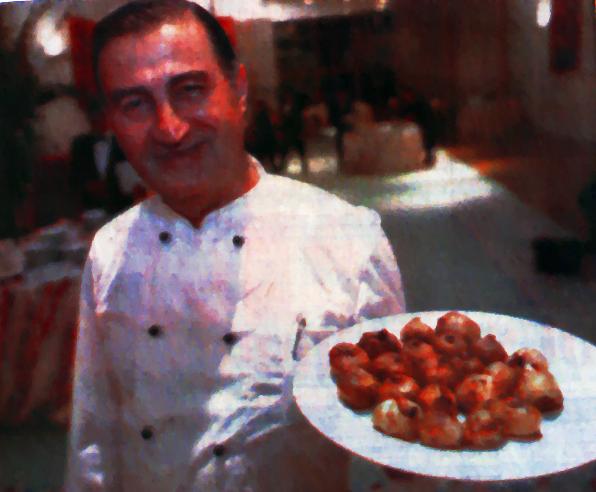
Basson is the owner
of the Eucalyptus Restaurant in the center of Jerusalem, a 70-seat
operation that has become well knownfor what he calls "the
food of the land of Israel." And what is that, he is asked.
Is that like Italian food or French food?
Not at all, says Basson.
"Israeli cuisine is like a Sabra." he says, referring
to a native-born Israeli, "a mix of everything - Polish,
Oriental, Moroccan."
Basson's food at Eucalyptus
is also a contemporary version of the food of the Bible, its ingredients
and, often, its cooking styles. "This is the proper Israeli
food." he contends.
The food can be a
little hard to re-create thousands of miles from his homeland.
In Washington recently for the Kennedy Center festival honoring
the 50th anniversary of the state of Israel, the Iraqi-born chef
presented some of the restaurant's signature dishes at a sold-out
cooking demonstration and dinner.
And as luck would
have it, there was no khubeiza to be found locally.
Basson's dinner required
ingredients like khubeiza (that's the Arabic name for the fruit
of the mallow plant, whose leaves he needed), silan (a honey-like
date syrup), tamarind and tiny eggplants. Anticipating difficulty,
Basson brought the tamarind and silan from home. He never did
find enough small eggplants, and the khubeiza, which grows abundantly
in Israel, had to be rushed from California at the last minute.
He was surprised.
"khubeiza grows all around the world," he says, "especially
in areas where people live - even in the deserts," - as long
as there has been human habitation.
Spending time with
Basson is like talking with a philosopher, an etymologist, a food
historian and a Bible commentator, all at once. When the subject
is the needed khubeiza, you'll hear about how during the 1948
war, when food was incredibly scarce, people braved gunfire to
collect the wild plant, and the government published recipes for
it; or how Jesus told his mother to pay for bread with mallow
branches when the family had no money (after a few days, the story
goes, the branches turned to gold).
Ask him a simple question
- such as how something is spelled in English- and he answers
with a story, a learned digression, the spelling and meaning of
the word in Hebrew, Arabic and Latin, and medical uses for the
relevant food or ingredient herbs. How many chefs tell you that
sesame-seed paste is full of iron, or that sage leaves have great
healing properties for stomach ailments?
Metaphysics and medicine
aside, a conversation with Basson is also an encounter with a
respectful son. "My food is the food for mothers," he
told the audience at the Kennedy Center. "My mother, and
her mother, and Druze mothers, and Arab mothers."
Basson's family moved
to Israel from Iraq in 1950, a few months after he was born. As
a boy, young Moshe had a passion for science and a predilection
for collecting wild plants - artichokes were a favorite - that
drove his mother wild. "She was sure they were poison,"
he recalls.
His father owned a
bakery near a Palestinian village that straddled the border between
Jordan and Israel. Basson remembers good relationships between
the Jewish and Arab families there - so good that one day when
he wandered across the border while gathering wildflowers from
the hills near unseen Jordanian army troops, an Arab neighbor
called his father to worn him.
Food was often a link
to friendship between the communities: His father sold sweet bagels
and Iraqi-style Jewish holiday treats on both sides of the border
using a long stick to reach over the fence and collect money.
And Basson still can conjure up the tantalizing smells emanating
from the village women's kitchens - especially stuffed breads.
The aroma of these forbidden foods was the start of the love of
[the Palestinian] kitchen," he says.
But he didn't really
learn to cook till he was a 21-year old army officer commanding
a small outpost on the Suez Canal. The cook didn't know how to
cook, but the soldiers had to be fed. In desperation, Basson regularly
called his mother for culinary instructions, and ended up making
many of the meals himself. "It was easier to do it than explain
it," he recalls.
A couple of civilian
jobs, including one as the personnel manager in a Jerusalem hotel,
followed. But Basson felt imprisoned in a suit and tie. Working
with the chefs in the hotel kitchen, he'd noticed they had no
access to many out-of-the-ordinary vegetables and herbs or game.
He quit his job, started a specialized farm, and when his brother
Jacov opened a small kebab shop in the family's former home in
1987, Basson acted as adviser. A year later his brother left and
Basson took over.
The restaurant incarnation
as a kebab house didn't last long. Basson was determined to make
the food unique and, soon enough, an answer emerged. In a country
riven by different religious and political attitudes, why not
look to the food of its past? It was different -and close to the
Iraqi cuisine he grew up with, as well as the forbidden Palestinian
foods whose aromas had tempted him as a child. It would attract
a broad spectrum of Israeli society , and it would give him a
chance to develop a menu of his own.
The idea worked. Jews
came. Tourists came. The Palestinians he grew up with came, to
order the food they'd eaten in their mother's kitchens. Like Ma'aluba-an
upside-down chicken, vegetable, potato and rice dish that Basson
prepared and served at the Kennedy Center dinner.
Ten years later, the
dishes at Eucalyptus draw on the traditions of Palestinian and
Iraqi Jewish cuisine, both of which Basson thinks are "windows"
into the foods of the Bible. The dishes he serves emphasize the
fish, poultry, lamb and beef indigenous to the area as well as
the seven agreed-upon agricultural products mentioned in the Old
Testament-wheat, oats, olives, figs, dates, pomegranates and grapes.
Some of the original
bitter herbs of the Passover Hagadah-wild chicory, dandelion leaves-
make their way onto the menu as well. But he doesn't turn his
nose up at products that have been there only for centuries, not
millennia:cyclamen leaves (which he stuffs), orchid-bulb powder
(which he uses for a dessert) and even tomatoes and potatoes of
the New World.
His meats and poultry
are grilled or stewed or stuffed into vegetables and a ravioli/kreplach-like
pastry called kubah. Vegetables are cooked with local herbs and
spices that have been in the region since the spice trade crossed
the Fertile Crescent.
Eucalyptus has continued
to be a family enterprise. His brother Jacov returned after a
couple of years. His mother makes the kubah. His father made the
honey-like date syrup needed for some of the desserts. Before
his father died a little over a year ago, the family realized
he'd made a lot more than usual. The family need it if he passed
away, he explained.
Basson is close to
his mother. She lives in her own apartment in the family house,
along with Basson, his wife, Maya, who works with kindergarten
children, and their three children, and does the primary cooking.
For the Passover Seder next weekend (he closes the restaurant
for the holiday), Basson will do the main meat dish, but his mother
is in charge of the rest.
Today, along with
tourists and visiting chefs, his restaurant attracts Israeli generals,
Palestinian Arabs, Jews who have settled in the Arab territory,
left -wing activists, those of all shades of Israeli political
opinion. "People [who] theoretically hate eachother,"
he says. "It's the only place they can find certain dishes...And
sometimes they eat together, without borders of religion, politics,
or nationality - even when I've seen them shaking their fists
at eachother on television a day earlier."
But there is one person
who regularly expresses a dissenting point of view-his mother.
"She thinks my
food is too salty," he says with a smile.
|
 Discount
coupons at kosher restaurants
Discount
coupons at kosher restaurants